
Permanent Collection Record
Images
Additional Images [3]
Metadata
Object ID |
2000.18 |
Collection |
Ceramics Collection |
Media Collection |
American Art Pottery Collection |
Manufacturer |
Weller Pottery Company (1872-1948) |
Title |
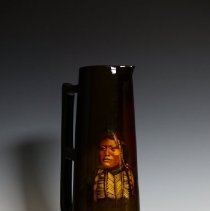
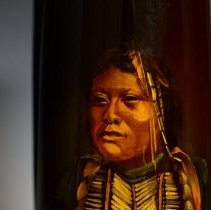
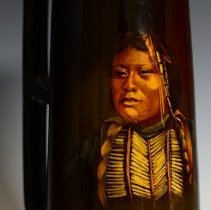
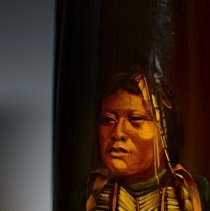
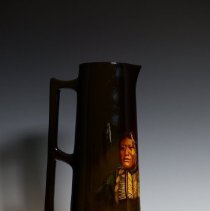
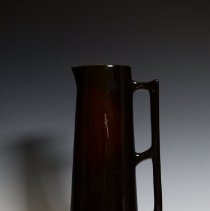
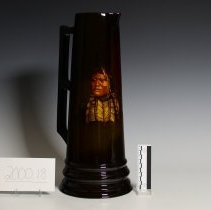
Utopian Lightweight Tankard Featuring a Portrait of the Oglala Lakota Warrior Tasunka Witko (Crazy Horse) |
Date |
1898-1901 |
Decorator |
Anna Fulton Best (1874-1955) |
Designer |
William A. Long (1844-1918) |
Cipher |
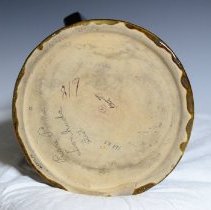
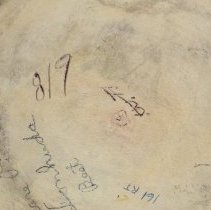
A stylized "AF.B." for Anna Fulton Best appears on the underside. |
Makers Marks |
This piece has a die-impressed Lonhuda Faience LF Shield manufacturer'smark, an incised "819" shape number, and an incised AFB decorator cipher on the vessel's underside. |
Description |
This is one of three rare, large Utopian Lightweight tankards in the museum's collection made at J. B. Owens Pottery Company (1885-1907) between 1898 and 1901. It bears an incised "819" shape number, most surprisingly, a die-impressed Weller Pottery Company Lonhuda Faience manufacturer's mark, and the decorator's cipher on the vessel's underside. Of the museum's three examples, this is the only piece that bears a LF shield mark, which makes this a curious piece. The tankard is undoubtably an Owen's Utopian Lightweight based on its size, shape, shape number, and decorator so why does it have the Lonhuda Faience maker's mark. The answer is unknown, and more research needs to be done. Could Owen's have sold the mold to Weller Pottery Company's Lonhuda Faience division? What we do know about this tankard is that it was hand painted by Anna Fulton Best (1874-1955), between 1898 and 1901 when Best was in her mid-twenties. Born in Kentucky, Best moved to Zanesville, Ohio in 1898 when she married Nolan R. Best (1871-1930) the Editor of the Zanesville Courier. By August 1901, she moved to Chicago with her husband who was offered a new position at a Chicago, Illinois newspaper. The tankard features a portrait of the First Nation Oglala Lakota warrior Tasunka Witko (commonly referred to as Crazy Horse (1838-1877). Portraits or depictions of people of the First Nations or Indigenous Americans were common on American art pottery and captured the early twentieth century nostalgia for the disappearing frontier. Paradoxically, forced migration policies and westward expansion were responsible for the vanishing west and its indigenous populations. |
Medium |
Earthenware, Glaze, Underglaze |
Technique |
Cast, Glazed, Underglaze Slip Painted, Sprayed with an Atomizer |
Height (in) |
17.000 |
Diameter (in) |
7.000 |
Culture |
American |
School |
Arts and Crafts Movement |
Place of Origin |
Zanesville, Ohio, United States |
Credit Line |
Gift of Raymond W. Thomas in Memory of Eva L. Thomas |
People |
Best, Anna Fulton Long, William A. Thomas, Raymond W. |
Search Terms |
American Art American Art Pottery American Artists American Ceramics Arts and Crafts Movement Atomizers Cast Clothing / Dress Female Artists Figures, Men Hand Decorated High Gloss Indigenous Americans Lonhuda Faience Oglala Lakota Ohio Art Ohio Artists Ohio Companies Ohio Designers Ohio Manufacturers Pitchers Pottery Artists Pottery Decorators Tasunka Witko (Crazy Horse) Underglaze Slip Painted Weller Pottery Company (1872-1948) Weller Pottery Company Early Lines Zanesville Artists Zanesville, Ohio |
Location |
On view in the American Art Pottery Gallery, 1st Floor |
Related Objects |
Show Related Records... |